
Nvidia vs Tesla: The Battle for the Future of Driving Just Got Real
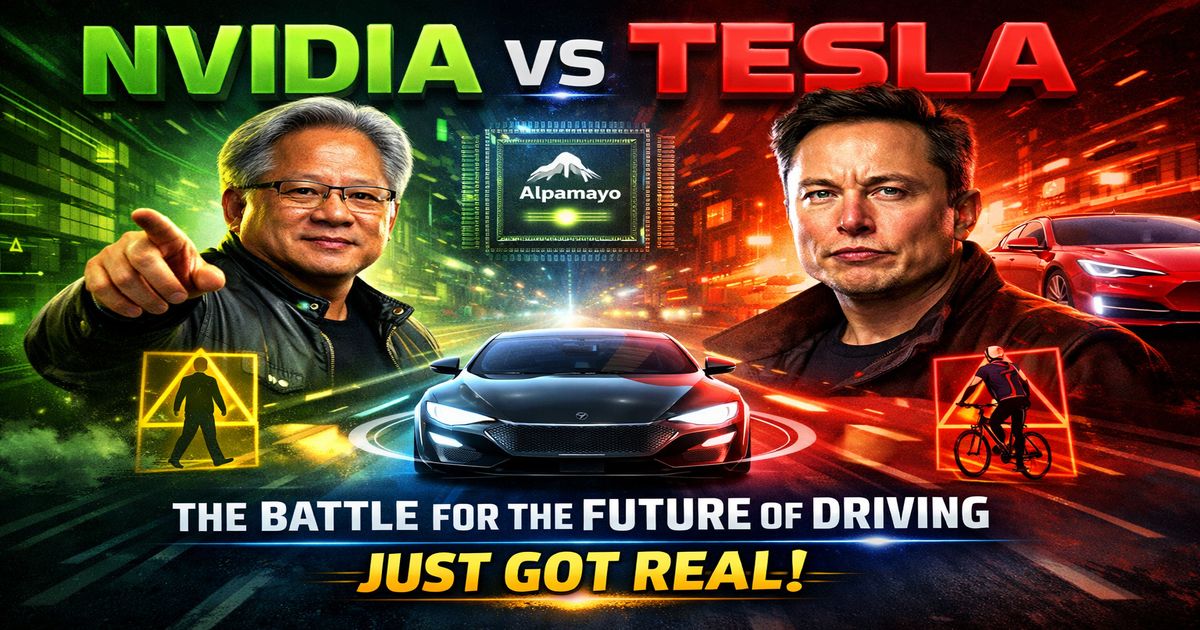
Nvidia's new Alpamayo platform challenges Tesla's dominance in autonomous driving by offering reasoning AI to all car manufacturers. A new era of self-driving competition has begun.
# Nvidia vs Tesla: The Battle for the Future of Driving Just Got Real
The battle for the future of self-driving cars just got a new heavyweight fighter. Nvidia, the company famous for making the chips that power AI, has officially stepped out of the background. At the CES technology conference in Las Vegas, Nvidia CEO Jensen Huang unveiled Alpamayo, a new software platform designed to give cars the ability to "reason" and "think" like a human. This matters because until now, Tesla has been the undisputed king of autonomous driving software. Now, Nvidia is offering a "super brain" to every other car maker—starting with Mercedes-Benz—to help them catch up.
The Big Shift: From "Seeing" to "Reasoning"
Current self-driving cars are great at "seeing" things (detecting a stop sign or a pedestrian). But they struggle with reasoning (understanding why a pedestrian is standing there). Nvidia calls this the "ChatGPT moment for physical AI." Just as ChatGPT can explain a complex joke, Alpamayo can explain why it decided to slow down. It moves the industry from cars that strictly follow rules to cars that understand context.
The Contenders: How They Compare
1. Nvidia's Alpamayo (The "Open" Challenger)
Nvidia is taking an "Android" approach. They aren't building a car; they are building the brain and selling it to everyone.
The "Why" Factor: Jensen Huang claims Alpamayo can "think through rare scenarios" and explain its decisions.
Example: If the car swerves, it can tell you, "I moved left because the cyclist looked unsteady," rather than just reacting silently.
Open Access: Nvidia made the code available on Hugging Face (a library for AI code). This allows researchers everywhere to test and improve it, potentially making it smarter, faster.
Real-World Launch: This isn't just a concept. A Mercedes-Benz powered by this tech is hitting US streets in the coming months.
2. Tesla's Autopilot (The "Walled" King
Tesla takes the "Apple" approach. They build the car, the chips, and the software, and they keep it all to themselves.
The Data Advantage: Tesla has millions of cars on the road collecting real-world driving data every day. This is a huge head start.
The Musk Defense: Elon Musk responded to the announcement with skepticism, noting that it's easy to get self-driving 99% right, but the "last 1%" (the long tail of rare events) is incredibly hard to solve.
Strategic Analysis: The $4.5 Trillion Bet
Nvidia is already the world's most valuable company (worth over $4.5 trillion), but they need physical products to keep growing. By launching Alpamayo, they are pivoting from just selling the "engine" (chips) to selling the "driver" (software).
This is a direct threat to Tesla. If Nvidia can sell a "Tesla-level" self-driving system to Ford, Toyota, and Mercedes, Tesla loses its main unique selling point. It levels the playing field. Suddenly, you don't need to buy a Tesla to get a car that drives itself; you just need a car with an Nvidia chip inside.
Forward-Looking Insight
For the average driver, this rivalry is excellent news. Competition breeds innovation.
Safer Rides: With "reasoning" AI, we might finally see cars that don't get confused by road construction or weird weather.
Trust: If a car can explain why it is driving a certain way ("I see a pothole ahead"), passengers will feel much safer letting go of the wheel.
Commonly Asked Questions
Q: Will my current car get this update?
A: No. This requires specific Nvidia hardware. It will likely appear in new models, starting with high-end Mercedes-Benz vehicles later this year.
Q: Is Nvidia building its own car?
A: No. Nvidia provides the brain (chips and software), but they partner with traditional car manufacturers to build the actual vehicle.
Q: What does Elon Musk think about this?
A: He is skeptical. He posted that Nvidia will find it "super hard" to solve the complex, rare situations that happen in real-world driving, which Tesla has been battling for years.
Q: What is "Physical AI"?
A: It is the next wave of AI. Instead of just existing on a screen (like a chatbot), Physical AI controls moving objects—like cars, robots, and drones—in the real world.